Pride Victory 10 review: the full-size scooter I recommend for daily use
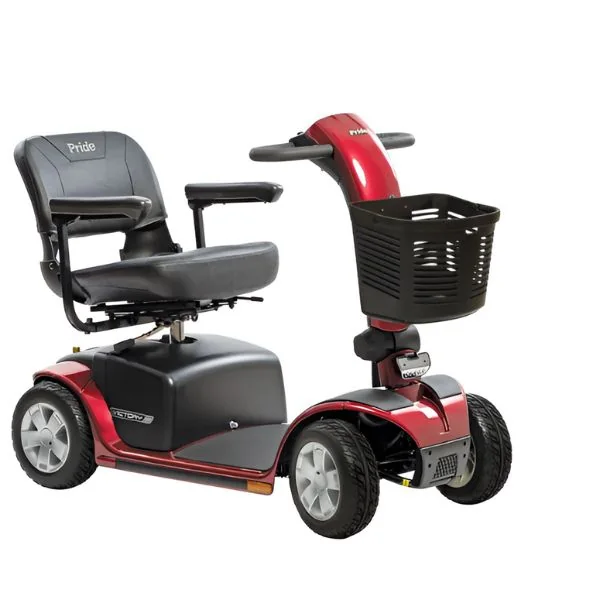
A full-size daily driver, not a travel scooter. The Victory 10 carries up to 400 pounds, goes 16 miles, hits 5.3 mph, and rides on 10 inch tires that soak up cracked sidewalks far better than little travel wheels. It comes apart if you must, but the heaviest piece is 61 pounds, so plan to leave it set up or use a lift.
Check price at Pride →- 400 lb weight capacity
- Up to 16 miles of range
- Faster 5.3 mph top speed
- 10 in tires ride smoother on rough pavement
- Large, comfortable adjustable seat
- Heavy at about 185 lbs total
- Heaviest piece is 61 lbs to lift
- Not practical to load in a car often
- Needs trunk room or a vehicle lift
A man came into a fitting last spring convinced he wanted the smallest scooter on the floor, the kind that folds into a suitcase. Two minutes after he sat on the Pride Victory 10, he stopped talking about folding. That happens often, because the scooter people fall for in the showroom is rarely the one that fits the life they actually live. The Victory 10 is a full-size four-wheel daily driver, not a fold-up that tags along on trips. It carries up to 400 lbs, travels up to 16 miles on a charge, tops out around 5.3 mph, and rides on big 10 inch tires that change how the whole machine feels underneath you.
That last point is the one I keep circling back to. The Victory 10 is comfortable and planted, and it is a pleasure around the house and the neighborhood. The catch is weight. It runs about 185 lbs all together, and the heaviest single piece is 61 lbs, which reshapes any conversation about getting it from your door to somewhere else. Below I will translate these numbers into what they mean for a real rider, point out exactly who the scooter suits, and tell you where I would send you to a different machine. My how we test page lays out the credentials and process behind these calls.
Who the Victory 10 is really for
Think of the Victory 10 as a stay-set-up scooter. It is built for the rider who wants one good machine that lives by the door or in the garage and earns its keep every single day. Rolling to the mailbox, down to the corner store, around the block, or across a big-box parking lot is exactly the kind of daily duty it handles with room to spare.
Comfort and stability are what it trades portability for. When you rarely need to break a scooter down and load it into a trunk, the weight stops being a daily problem at all. Most of the riders I have set up on a Victory 10 keep it assembled the whole time and simply drive it on and off a ramp or a vehicle lift. That is the sweet spot for this machine.
Capacity is the other reason to reach for it. A 400 lb weight rating carries more than the travel scooters I review, and that higher ceiling usually buys you a sturdier frame and a roomier seat. Riders who have found smaller scooters cramped or tippy tend to describe the Victory 10 as reassuringly solid. For a wider view of sturdy options, my heavy-duty scooter guide sets it alongside other higher-capacity models, and the weight and size guide explains how to leave yourself sensible headroom on the rating.
The 10 inch tires and why the ride is so much smoother
This is the spec I would underline above all the others. The Victory 10 runs on 10 inch tires, and bigger wheels make a real difference on the surfaces most of us actually cross. Cracked sidewalks, expansion joints, driveway lips, gravel paths, the little drop where pavement meets a curb cut. Small wheels jolt over all of that. Larger wheels roll across it.
For an older rider, a smoother ride is not a luxury. A hard jolt can hurt the back and hips, and it can feel unsettling enough that some people stop wanting to go out. When the ride stays calm and planted, you relax, you sit up straighter, and you go a little farther. I have watched that confidence return in person, and the tires are a big part of why.
Bigger tires and a bigger frame add up to a bigger, heavier scooter, which is the price of that comfort. You trade portability for a steadier ride. For the right person it is a fair trade, but it is still a trade, and you should make it on purpose rather than by accident.
Range, speed, and capacity in real terms
Pride rates the Victory 10 for up to 16 miles. Read that as a ceiling, not a promise, and plan your daily route around comfortably less so you always have a cushion to get home. What shrinks the number and by how much is covered properly in my battery guide, which walks through why a charge fades and gives a rule of thumb for the real-world figure.
Top speed sits around 5.3 mph, a sensible walking-plus pace that is a touch quicker than many travel scooters. For getting around safely on sidewalks and in stores, a steady ride, a tight enough turn, and a seat you can sit in for an hour matter far more than the headline speed. If you want to weigh those priorities the way I do when sizing a scooter to a person, my guide on how to choose a mobility scooter puts turning radius and fit ahead of the spec sheet.
The 400 lb weight capacity is the one number I would not compromise on. Picking a scooter rated comfortably above your weight protects the motor and battery and keeps the ride stable. Ride near the top of a lower-rated scooter's limit and you will feel it in sluggish hills and shorter range, so the Victory 10's higher ceiling is a genuine advantage for many riders.
| Spec | What it means for you |
|---|---|
| 400 lb capacity | Roomy headroom on weight, steadier ride, sturdier frame |
| Up to 16 mi range | Plenty for daily errands; plan for less than rated |
| 5.3 mph top speed | Brisk walking pace; safe and sensible for sidewalks and stores |
| 10 in tires | Smooths cracked sidewalks and curb cuts |
Comfort, seat, and steering
The Victory 10 ships with a large, comfortable seat, and on a daily driver that matters more than people expect. Spend real time on a scooter and the seat is where the day is won or lost. A bigger seat gives you room to shift your weight, supports your back, and keeps you from feeling perched on the edge. Over a longer outing, that is the difference between looking forward to a trip and dreading it.
Steering runs through Pride's EZ Turn system, with a rated turning radius around 45.5 inches. That is a wider arc than a little travel scooter asks for, because a four-wheel scooter is built for steadiness rather than spinning in place. Hallways, store aisles, and sidewalks are no trouble, though a very tight bathroom or a cramped apartment kitchen may ask for a three-point turn. The Victory 10 sits on four wheels, which favors a stable base over the tightest turns; to see how that choice plays out against three, read my piece on three versus four wheels. If your home has narrow indoor spaces, measure your doorways and turns before you commit.
Weight and transport: the part that decides the fit
The Victory 10 weighs about 185 lbs all together. It does disassemble for transport, which helps, but the heaviest single piece is around 61 lbs. The piece you hoist is that 61 lb section, not the 185 lb total, and that one number decides whether this scooter fits your car. Wrestling 61 lbs into a trunk once is doable for many helpers; doing it several times a week is a different ask, and that gap is explained in detail, model by model, in the weight and size guide.
If your plan is loading this scooter into a sedan trunk by hand a few times a week, it is the wrong tool, and someone will eventually get worn out or hurt doing it. The Victory 10 works best staying assembled, riding on a vehicle lift fitted to an SUV, van, or truck, or simply living at home while you drive it locally.
When frequent vehicle transport is your real need, I would point you toward a lighter travel scooter that splits into smaller pieces, or an auto-folding model. My guide on how to choose a mobility scooter walks through matching the machine to your vehicle and your helper's strength, which should come before any spec comparison.
Where the Victory 10 fits, and where it does not
For the rider who wants comfort, capacity, and a smooth ride for daily life, and who can keep the scooter set up or use a lift, the Victory 10 is a strong recommendation. It is steady, it is roomy, and those 10 inch tires turn ordinary outings into pleasant ones. As a workhorse for neighborhood independence, it earns its place by the door.
The dealbreaker is frequent car transport by hand. When life revolves around lifting the scooter in and out of a sedan, the weight, not the quality, is what rules it out. Worth flagging too: a scooter is not a power wheelchair. You steer the Victory 10 with a tiller and transfer onto a swivel seat, while a power chair suits different bodies and tighter indoor spaces. Anyone weighing the two should read my comparison of scooters versus power wheelchairs before spending a dollar.
One more boundary. Riders whose real goal is rougher ground or longer recreational rides will find the Victory 10 comfortable but not built for that the way a dedicated recreational model is; for them I point to my best outdoor scooter roundup instead. For most people who want a dependable daily driver that stays put and gets used, though, this is the scooter I keep coming back to.
Check current pricing and any bundle or free-shipping deals from a trusted mobility retailer. Prices move with sales.
Affiliate link. We may earn a commission at no extra cost to you. It never changes our rankings (see how we test). We are not a medical provider; for a prescription scooter, talk to your doctor.
Frequently asked questions
Can I transport the Pride Victory 10 in my car?
You can, with eyes open about what it asks of you. It disassembles for transport, but the heaviest single piece is about 61 lbs and the whole scooter runs around 185 lbs. Lifting a 61 lb piece into a trunk again and again is hard on a back and not realistic for many helpers. The Victory 10 is happiest staying assembled and loaded with a vehicle lift on an SUV or van, or simply living at home for local driving. If you need to load a scooter into a car by hand often, a lighter travel model is the wiser pick.
Is the Victory 10 good for everyday use?
Yes, that is exactly what it is built for. With up to 16 miles of range, a 400 lb capacity, a large comfortable seat, and 10 inch tires that smooth out cracked sidewalks, it handles daily errands and neighborhood trips with room to spare. Think of it as a stay-set-up daily driver rather than a fold-and-fly travel scooter.
How is the ride compared to a small travel scooter?
Noticeably smoother and steadier, in my experience. The 10 inch tires roll over curb cuts, expansion joints, and rough pavement instead of jolting across them, and the larger frame feels more planted. Small travel scooters win on portability, but they cannot match this kind of ride comfort. You are trading a heavier, less portable machine for a calmer, more confident outing.
Will Medicare pay for the Pride Victory 10?
I cannot promise that, and please be wary of anyone who does. Medicare Part B may help with a mobility scooter only when a doctor prescribes it for a medical need inside your home, and the paperwork and rules are strict. Coverage is never guaranteed, and the specific model that qualifies is up to your doctor and supplier. Talk with your physician about whether you meet the requirements, and confirm the details with Medicare directly before you count on any help.
Is the turning radius tight enough for indoor use?
For most homes, yes, with a little care. The EZ Turn radius is about 45.5 inches, which is fine for hallways and store aisles but wider than a small three-wheel scooter. A very narrow bathroom or a cramped kitchen may need a three-point turn. Measure your doorways and turning spots first if your indoor spaces are tight, since that real-world fit matters more than any single spec.

I spent years helping older adults choose and fit mobility scooters, and I test these myself. I write every review and guide here, and I rank by what actually keeps a rider safe and independent, not by who pays the most. I am not a doctor. How we test →